Australia’s data centre boom is also a facilities problem
Australia now has 162 operational data centres, with more than 90 in the pipeline. That build-out sits within a broader investment surge that has been compared with the scale of the mining investment boom, though data centres are one part of that wider pipeline.
Growth at this pace puts real pressure on facility management to keep up. More sites mean more racks, more critical load and less tolerance for problems that would barely register in an office building. A leak that means a maintenance ticket somewhere else can mean downtime here. A humidity swing that’s a comfort complaint elsewhere can mean condensation risk on equipment worth millions.
Water ingress: the failure mode that rewards early detection
Water can originate around precision cooling equipment, including CRAC units and chilled-water CRAH units, as well as along chilled-water lines, condensate systems and other critical routes. These known risk points are a sensible place to start, but leaks can just as easily come from condensate systems, humidifiers, fire suppression infrastructure, roof penetrations, plumbing risers, liquid-cooling systems or building envelope failures. Effective coverage means mapping the routes that matter for a given site, not just the usual suspects.
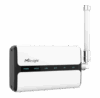
This is a problem built for early detection, not inspection. Milesight’s EM300-SLD, for example, is designed to detect conductive liquid at the sensing point and transmit an alarm over LoRaWAN, giving facility teams a head start before water reaches equipment, subject to appropriate sensor placement, network coverage and alert configuration. For very low-level spot detection, Milesight offers other sensors with different trigger conditions. Pairing detection with a LoRaWAN-based shutoff valve can automate the response, though that needs compatible valve hardware, proper configuration, and safeguards so a shutoff doesn’t interrupt cooling or other services it shouldn’t.
Thermal and humidity drift: the slow failure
Unlike a leak, environmental drift doesn’t announce itself. Equipment has both a recommended and a wider allowable operating range, and a brief excursion outside the recommended band isn’t automatically an incident. Extended operation near or beyond allowable limits is where reliability risk builds. Continuous monitoring of temperature, relative humidity and dew point across equipment zones, not just at the cooling unit, is what catches drift while it is still a trend worth watching.
Explore Indoor Temperature Monitoring →
Air quality is part of the picture too
Particulate and gaseous contamination is a less visible risk, but a real one, particularly in facilities using outside-air economisers or free cooling. International guidance from ASHRAE identifies airborne contaminants as potential contributors to corrosion and equipment reliability risk. For sites exposed to outdoor pollution, dust, salt or industrial emissions, filtration, cleanliness management and site-specific contamination or corrosivity assessment may be worth factoring in alongside the more familiar leak and thermal checks.
Please note: ASHRAE guidance is not an Australian regulation, but it provides a useful international technical reference for assessing data-centre environmental conditions.
Facility-wide visibility, not siloed point sensors
Leak detection, temperature monitoring, energy visibility and air-quality monitoring all lose value when they remain isolated readings that nobody reviews consistently. The real benefit comes from bringing relevant data into a shared view, whether that’s an existing BMS or DCIM platform, or a dedicated monitoring system, so an alert doesn’t get missed because the right person wasn’t looking at that particular screen. Milesight’s facility management and energy management solutions are one example of this approach, LoRaWAN sensor networks feeding a shared platform, with water management and HVAC monitoring built around the same idea: consolidated data instead of scattered readings.
What this looks like in practice
Milesight’s case work on data centre water leak detection is a useful reference point: sensors positioned at known risk points and along critical pipe routes, reporting leaks as they’re detected, with the option to pair detection with an automated shutoff where the site’s configuration supports it.
A sharper monitoring playbook
Pulling this together, a more complete approach to data centre monitoring covers:
- Detecting water at known risk points and along critical pipe routes
- Monitoring temperature, relative humidity and dew point across equipment zones, not just at the CRAC unit
- Tracking energy and HVAC performance for abnormal trends
- Connecting alerts to defined escalation and response procedures, so detection leads to action
- Reviewing historical data to spot recurring faults, not just responding to individual alarms
- Extending monitoring to air cleanliness and contamination where site conditions justify it
The takeaway
Data centres don’t need a different category of monitoring. They need the same fundamentals, leak detection, temperature control, air quality and energy visibility, applied with less margin for error and paired with a clear response when something trips. As the build-out continues, the facilities that put this approach in place now will be better positioned to detect problems early and avoid costly disruption later.
Talk to our team about sensor placement, network coverage and alert setup.