
NEW RELEASE

Kunak AIR Air Quality Monitoring System in Australia


Standards and Data Quality

Kunak AIR stations offer performance levels close to reference standards, providing reliable, accurate data according to Class 1 of the European CEN/TS 17660; protocols, metrics, and target values of EPA/600/R-20/279 for O3, EPA/600/R-23/14 for NO2, CO, and SO2, EPA/600/R-20/280 for PM2.5, and EPA/600/R-23/145 for PM10.

Also, data is traceable to international recognised standards
(European Directive 2024/2881 and USEPA 40 CFR Part 53).

A Complete Monitoring System

  • Monitoring Base Unit

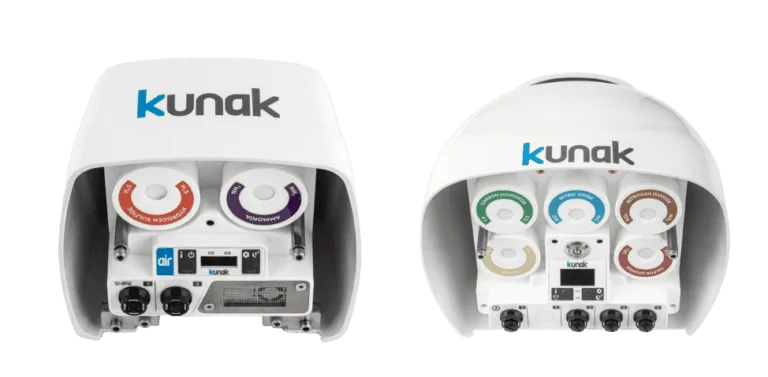
    Kunak air quality monitoring stations form the foundation of the solution. Two base units are available, allowing systems to be matched to the scale and complexity of each application.


    • AIR Pro supports advanced, multi-pollutant monitoring with particulate matter and up to five gases in a single unit.
    • AIR Lite offers a compact, cost-effective option for distributed networks and targeted monitoring, measuring particulate matter and up to two gases.

    Both stations are designed for long-term outdoor deployment, making them suitable for outdoor air quality monitoring applications. They feature IP65 protection and flexible power options.

    👉 Compare Kunak AIR Pro and AIR Lite

  • Smart Sensor Cartridges

    Kunak’s patented plug-and-play smart cartridges allow monitoring systems to be configured around specific pollutants, and are easily adapted as requirements change.

    With over 20 interchangeable cartridges, Kunak AIR can monitor a wide range of gases and particulates; including methane (CH₄), volatile organic compounds (VOCs), carbon-based gases such as CO and CO₂, and particulate matter (PM₁, PM₂.₅, PM₁₀ and beyond).

    Sensors can be swapped on-site in minutes, without returning equipment to the factory. This flexibility reduces downtime, simplifies maintenance and lowers lifetime ownership costs.

    👉 Explore Kunak gas & particle sensors

  • Cloud Software & Data Management

    Kunak AIR stations connect to Kunak Cloud, a web-based platform that provides full visibility and control over your monitoring network.


    From real-time dashboards and analytics to remote diagnostics, calibration workflows, and reporting tools, Kunak Cloud supports everything from daily monitoring to compliance reporting and long-term trend analysis.

    👉 Discover Kunak Cloud software options

  • Accessories & Environmental Add-Ons

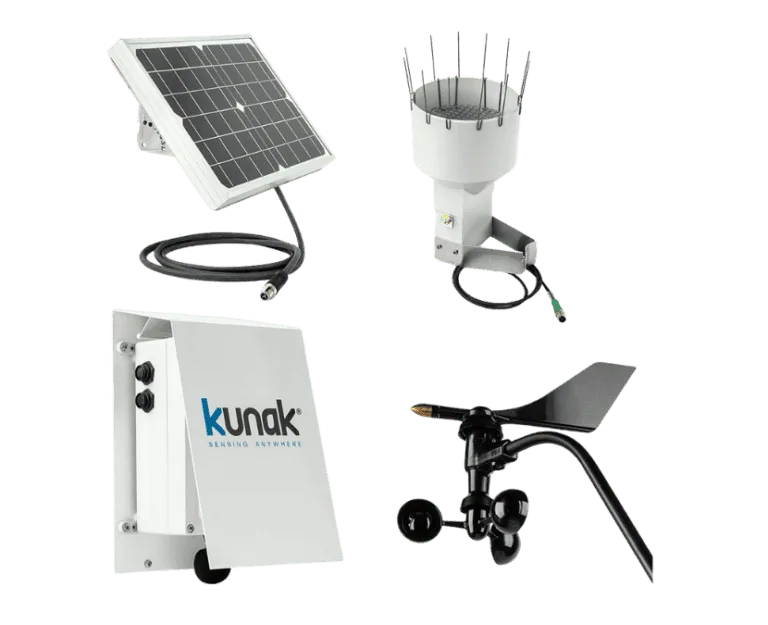
    To support accurate, site-specific air quality monitoring, Kunak AIR solutions can be paired with a range of accessories and meteorological sensors.


    These components enhance data quality and ensure reliable operation across diverse environments, including:

    • Meteorological sensors (wind speed, wind direction, temperature, humidity, pressure)
    • Power and solar options
    • Mounting and enclosure accessories
    • Communications hardware

    Meteorological data plays a critical role in interpreting air quality measurements, helping identify pollutant sources, understand dispersion patterns, and support defensible reporting.

    👉 Explore Kunak accessories & meteo sensors

Frequently Asked Questions

  • How accurate is the Kunak AIR monitoring system?

    Kunak AIR is built to perform close to reference standards. Kunak reports Class 1 performance under the European CEN/TS 17660 test, and uses US EPA target values for O3, NO2, CO, SO2, PM2.5 and PM10. Accuracy on site also depends on good calibration and the right location. OneTemp can help with both.

  • What does CEN/TS 17660 Class 1 mean?

    CEN/TS 17660 is a European test method for air quality sensor systems. Class 1 is the highest class. It means the system was tested against reference instruments and met the strictest targets in that test (to confirm the exact wording with Kunak).

  • What can Kunak AIR measure?

    It measures dust (PM1, PM2.5, PM10) and many gases using plug-in sensor cartridges. These include CO, CO2, NO, NO2, O3, SO2, H2S, NH3, methane and VOCs. There are over 20 cartridges. It also measures temperature, humidity, and pressure, and you can add wind sensors.

  • What is the difference between AIR Pro and AIR Lite?

    AIR Pro measures dust plus up to five gases in one unit. AIR Lite is smaller and lower cost, and measures dust plus up to two gases. It suits larger networks and simple monitoring. Both are made for outdoor use (IP65) and use the same cartridges.

  • How often is calibration needed, and can OneTemp do it in Australia?

    Yes, OneTemp offers online calibration and support in Australia, so the unit does not need to go overseas. Calibration uses two points (zero and span), and a gas hood with a certified gas cylinder can be used. How often it is needed depends on the gas, the site, and how it is used (to confirm with the technical team).

  • How does the data reach the cloud, and can I connect it to other systems?

    The station sends data wirelessly to Kunak Cloud, where you can see live dashboards, check the device, and make reports. It also supports Modbus RTU, so data can be read on site without internet. Network options and export formats are to be confirmed before quoting.

  • Can I use the data for compliance reporting?

    Kunak Cloud has reporting tools, and the data can be traced to international standards. Whether a regulator accepts sensor-based data depends on your licence and conditions. Check with the regulator, for example, your state EPA.

Want to learn more about Kunak's Air Pollution Monitoring Solutions?

Fill in the form below and request your copy of Kunak's brochure where you can explore detailed specifications, sensor options, and system capabilities.

Name(Required)


ENEWS PREFERENCES*(Required)